Ne9 is being prepared for sale as a food product in Japan and is not yet on sale. See the product specifications and launch plans for current amounts, three planned flavours and indicative price.
A caffeine pouch is a general name for powder containing caffeine, sealed into a small non-woven pouch. You hold it in your mouth without chewing or swallowing it, then remove it after use. Ingredients and legal classification must be checked product by product. Ne9 is being prepared for sale as a food in Japan.
It is not a drink, so there is no water or cup involved. It can be handled in a meeting or during a task without occupying your hands — that is the clearest difference.
The format is still uncommon in Japan, but pouches held in the mouth are a well established product category across the Nordic countries.
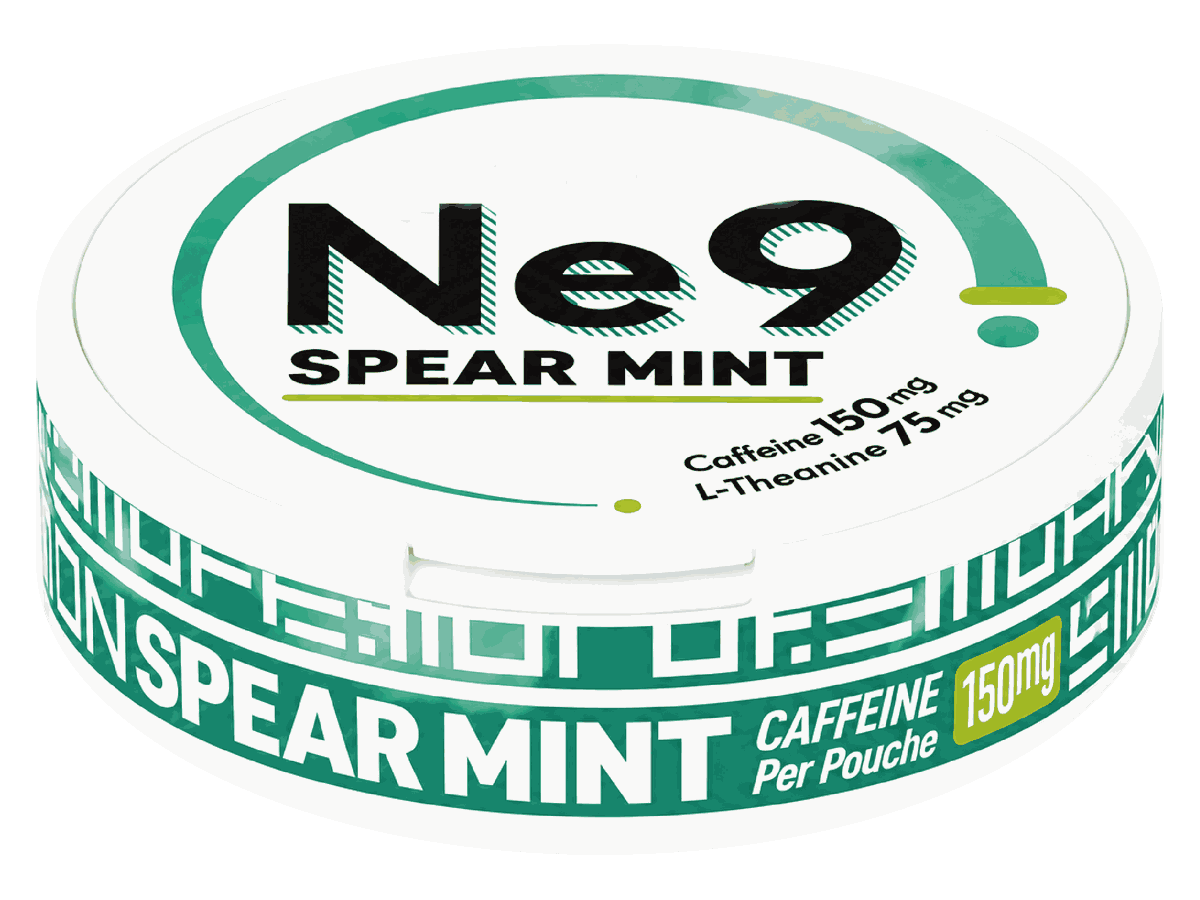
The can fits in the palm of your hand and holds the pouches side by side. On some products the lid doubles as temporary storage for used pouches (pictured: Ne9).
How it differs from a drink
The main difference is that the act of drinking disappears entirely.
| Caffeine pouch | Coffee | Energy drink | |
|---|---|---|---|
| Drinking | Not needed | Needed | Needed |
| Water / equipment | Not needed | Needed | Not needed |
| After use | Dispose of the used pouch (some cans temporarily store it) | Wash or dispose of the cup | Dispose of the empty can |
| Where it works | Meetings, before or after travel, mid-task | Needs a seat and time | Must be finished and the container handled |
| Knowing the amount | Printed on the pack | Varies with brewing | Varies by product |
| Sugar | Varies (often none) | None if black | Varies by product |
In a meeting you cannot get up. While travelling, handling a drink can be inconvenient. Sometimes your hands are simply not free. The gap a pouch tries to fill is not a lack of drinks — it is that there was no format you could use on the spot.
There is a second, more practical difference: the amount is countable. Coffee varies with the beans and the brewing, whereas a pouch has a fixed amount per unit, so you know what you have taken.
What defines the format
No drink involved
No water, no cup. Nothing to brew, nothing to wait for, nothing to finish. It works when you cannot leave your seat, or when both hands are busy.
Places where drinks are not allowed — libraries, vehicles, near equipment — are where the difference is most obvious.
Nothing is burned
There is no combustion. No smoke, no vapour, no smell left behind and nothing drifting toward anyone nearby. It is also visually discreet.
Ne9 is confectionery powder sealed in non-woven fabric, labelled as a food.
Flavours to choose from
Mint, fruit and coffee flavours are common, depending on the product. Some brands keep the composition identical across flavours and vary only the scent.
Being able to choose by taste is something purely functional products do not offer.
The same shape does not mean the same contents
Small pouches held in the mouth come in several kinds, and the shape tells you nothing about what is inside. Categories and formulations differ from product to product, so read the ingredient label, not the shape or the name.
Ne9 is confectionery powder sealed in non-woven fabric, designed and labelled as a food, with 150mg of caffeine and 75mg of L-theanine per pouch.
How caffeine pouches are positioned in Japan, and what separates a food from a medicine, is covered in how caffeine pouches are treated in Japan.
About the term "refresh pouch"
In Japan the term "refresh pouch" has started to appear. It does not describe the contents. The name alone does not tell you what is in a product, or how much.
When choosing, read the ingredients rather than the category name.
How it is used
- Take one pouch out
- Hold it in your mouth
- Leave it there — do not chew, do not swallow
- Remove it from your mouth and dispose of it when done (some cans temporarily store used pouches)
Do not chew or swallow it while in use. Always remove it from your mouth after use. No water is needed.
How long it lasts
How long the flavour lasts varies by product — roughly 30 to 90 minutes. Fading flavour is the usual cue that it is time to change.
For Ne9 it is about 90 minutes.
How to read the caffeine figure
The amount per pouch varies between products. Check the pack before you buy.
For reference, here is what a single serving of everyday drinks contains.
| Serving | Approximate caffeine | |
|---|---|---|
| Sencha (green tea) | 150ml | about 30mg |
| Black tea | 150ml | about 45mg |
| Coffee | 150ml | about 90mg |
| Energy drink | Varies | about 36–150mg |
| Gyokuro (shaded green tea) | 150ml | about 180mg |
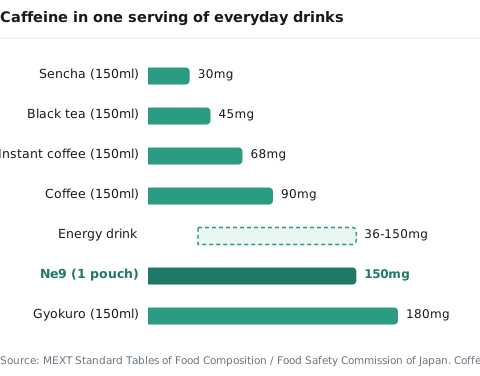
Figures are approximations based on Japan's Standard Tables of Food Composition (MEXT) and material published by the Food Safety Commission of Japan.
The daily guideline
Japan has not set a national upper limit for caffeine in food, but other authorities publish the following:
- European Food Safety Authority (EFSA): up to 400mg a day for healthy adults, and up to 200mg at a time
- Health Canada: up to 400mg a day for healthy adults
The single-serving figure is easy to miss. The higher the caffeine content of a pouch, the closer one unit sits to that per-serving figure.
Remember that coffee and tea count toward the same total.
There is more in How much caffeine a day is the guideline?
How it is classified in Japan
A product's legal status is assessed individually from factors including ingredients, form, directions for use and advertised claims. Ne9 is designed and labelled as a food. It is not a medicine.
Before buying, check that the pack states its classification, ingredients, caffeine content, daily guideline and warnings. Japan's Ministry of Health, Labour and Welfare publishes the criteria used to distinguish medicines.
Storage and carrying
- Keep away from direct sunlight, heat and humidity
- Keep out of reach of children and pets
- Most products travel in their can and take up little space
- Put used pouches in the can's compartment if it has one; otherwise wrap and bin them
What to look at when choosing
- Caffeine content — how many mg per pouch. Work backwards from the daily guideline
- The ingredients — similar-looking products differ inside. Read the label, not the name
- Sugar — often none, but it varies
- Whether it is labelled as a food
- Flavour — including how long it lasts, which also varies
Common questions
How do I tell one product from another that looks similar?
The ingredient label. Small pouches held in the mouth come in several kinds, and the shape and name tell you nothing about the contents. Check the ingredients before buying.
What if I swallow it?
Do not swallow the pouch itself. It is intended to be held in the mouth.
How many can I use in a day?
Each product sets its own daily guideline. Follow the pack, and account for coffee, tea and other sources of caffeine.
How do I tell a food from a medicine?
Check that the packaging states that it is a food, with ingredients, amounts, a daily guideline and cautions. The criteria are covered in how caffeine pouches are treated in Japan. A caffeine pouch is a food and contains neither.
Can I buy them in Japan?
Yes. Some retailers sell them online, though availability and launch timing vary by product.
Can I use one during pregnancy?
Lower caffeine intake is recommended during pregnancy and breastfeeding. Avoid use, or ask a doctor first.
Before you use one
- If you are pregnant or breastfeeding, sensitive to caffeine, on medication or under treatment, avoid use or ask a doctor first
- Avoid using it before bed
- Do not swallow the pouch
- Keep out of reach of children and pets
Ne9 is a single-serve pouch of confectionery powder sealed in non-woven fabric — a food product. 150mg of caffeine and 75mg of L-theanine per pouch. No sugar. Flavours are Spear Mint, Tropical and Creamy Coffee, at about ¥80 per use. It has not launched yet — you can sign up for updates (the form is in Japanese).
This is a food product, not a medicine. It is not intended to diagnose, treat, cure or prevent any disease.
Sources behind the amounts
The drink comparison uses the food table in the Food Safety Commission of Japan caffeine factsheet. The comparison concerns caffeine content, not equal absorption or speed of uptake from drinks and pouches.
The 200mg single-dose and 400mg daily figures come from EFSA's assessment for healthy adults. They are not Japanese statutory limits or product-specific safety findings for Ne9. See the MHLW caffeine Q&A for Japanese public guidance. Ne9's approximate 90-minute figure describes planned taste duration, not a duration of physiological effects.