Ne9 is being prepared for sale as a food product in Japan and is not yet on sale. See the product specifications and launch plans for current amounts, three planned flavours and indicative price.
The daily guideline for caffeine is around 400mg for a healthy adult — roughly four to five cups of coffee.
"Four cups of coffee" is not much help if you do not know how many cups you are already on. So let us line up single servings first.
Next to everyday drinks
| Serving | Approximate caffeine | |
|---|---|---|
| Sencha (green tea) | 150ml | about 30mg |
| Black tea | 150ml | about 45mg |
| Instant coffee | 150ml | about 68mg |
| Coffee (brewed) | 150ml | about 90mg |
| Energy drink | Varies | about 36–150mg |
| Ne9 (caffeine pouch) | 1 pouch | 150mg |
| Gyokuro (shaded green tea) | 150ml | about 180mg |
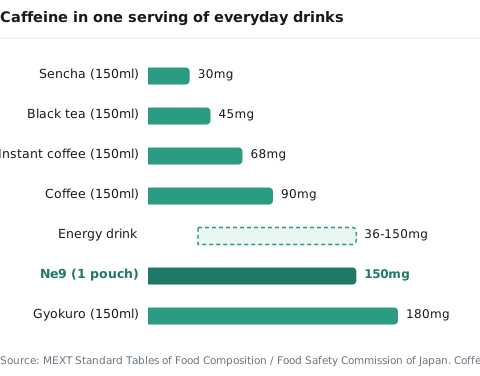
Figures are approximations based on Japan's Standard Tables of Food Composition (MEXT) and material published by the Food Safety Commission of Japan. Coffee varies a great deal with the amount of grounds and the brewing method.
Lined up this way, a single serving lands somewhere between 30mg and 180mg. Gyokuro is higher than most people expect, and energy drinks vary by a factor of four between products.
The daily guideline
Japan has not set a national upper limit for caffeine in food. Other authorities publish the following guidance:
- European Food Safety Authority (EFSA): up to 400mg a day for healthy adults, and up to 200mg at a time
- Health Canada: up to 400mg a day for healthy adults
The single-serving figure (200mg) is easy to miss. There is guidance not only on the daily total but on how much you take at once.
Note that people differ a great deal. The same amount that keeps one person awake at night may not register at all for someone else. Lower amounts are recommended during pregnancy and breastfeeding, and the specific figure varies between authorities.
Going over it
Too much caffeine can cause dizziness, a raised heart rate, agitation, anxiety, tremor, difficulty sleeping, diarrhoea and nausea.
This is why authorities publish daily guidelines at all. Knowing what you have taken, and how much, makes staying inside those guidelines easier.
Coffee is awkward here, because the amount per cup depends on how it was made. You can count three cups and still not know whether that was 180mg or 300mg.
In the case of Ne9
Ne9 contains 150mg of caffeine and 75mg of L-theanine per pouch, with a daily guideline of up to 2 pouches.
Two pouches is 300mg, which leaves about 100mg before the 400mg guideline — roughly one cup of coffee. Adjust for whatever else you drink.
The amounts are printed on the pack, so what you are taking is readable before you buy and while you use it.
Common questions
Is there a legal upper limit for caffeine?
Japan has not set a national upper limit for caffeine in food. Internationally, EFSA and Health Canada both publish a guideline of 400mg a day for healthy adults.
How much at one time?
EFSA also publishes a per-serving figure of up to 200mg. There is guidance on how much you take at once, not only on the daily total.
How much is in a cup of coffee?
About 90mg for 150ml of brewed coffee, though it varies a great deal with the beans and method.
Is the guideline different during pregnancy?
Lower amounts are recommended during pregnancy and breastfeeding, and the figure varies between authorities. Ask a doctor.
What happens if I have too much?
Dizziness, a raised heart rate, agitation, anxiety, tremor, difficulty sleeping, diarrhoea and nausea can occur.
- If you are pregnant or breastfeeding, sensitive to caffeine, on medication or under treatment, avoid use or ask a doctor first
- Avoid using it before bed
- This is a food product. It is not intended to diagnose, treat, cure or prevent any disease
About Ne9 / Sign up for updates
Who the assessment applies to
EFSA's caffeine assessment discusses 200mg single doses and 400mg per day for healthy adults, with separate considerations for pregnancy and other groups. It does not assess people with diseases or combinations with medicines. These figures are not a daily allowance that should be filled.
The MHLW Q&A and Food Safety Commission factsheet also explain individual differences and overconsumption. As arithmetic only, two Ne9 pouches contain 150mg × 2 = 300mg; adding the approximate 90mg in 150ml of coffee gives 390mg. This example is not a recommendation to use that combination.